Worn. Cracked. Torn. Or a hole right through. Wear on the palm pad can look different – but the cause is the same.
It is one of the most common wear patterns we see on golf gloves.
The skin becomes shiny and thin. It wears out. Cracks. Tears up. Sometimes there is a clear hole.
Always in the same place: the thick cushion at the bottom of the palm.
Wear on the palm pad means the club grip moves towards the glove.
A wear requires movement
When the club is held steady, the hand, glove and club grip follow each other throughout the swing. They move together.
But when the club is not held firmly by the fingers, the club grip can move towards the palm of your hand. The movement doesn't have to be large. It can be so small that you never notice it.
You may not notice the movement. But the glove does.
Same point. Same movement. Blow after blow.
The appearance of wear can vary. The leather can fray thin, crack, tear or eventually get a hole. But the mechanism is the same: movement creates friction – and friction creates wear.
It's the fingers that hold the club.
The key is where the club rests in the hand. If it rests too much in the palm, the end of the club ends up near the cushion at the bottom of the hand. There it can move against the glove and create the typical wear.
When the club is instead placed more over the fingers, it is held more stable and the end of the club moves away from the cushion of the palm. The picture shows the difference.
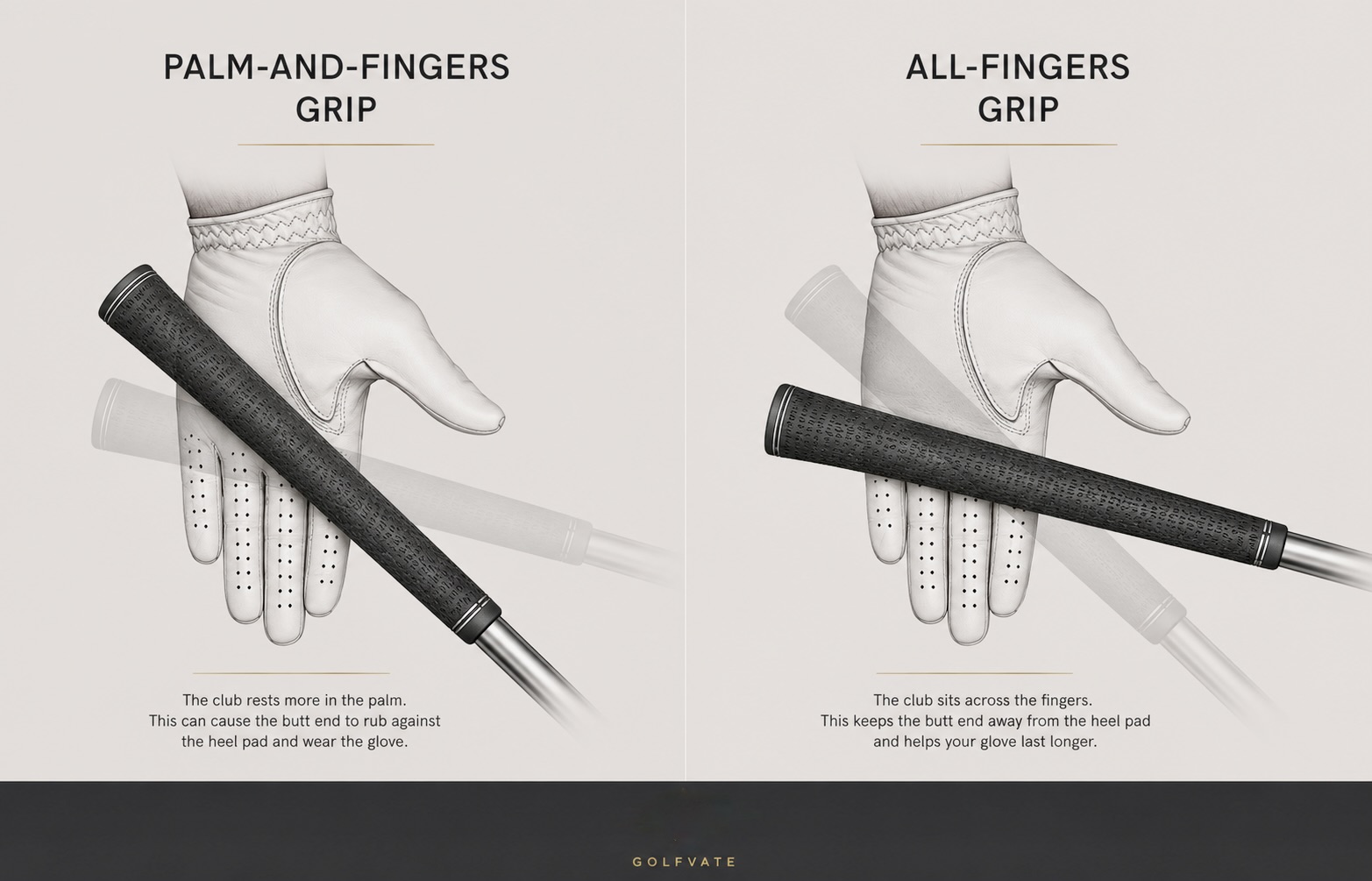
On the left, the club rests more in the palm of the hand. On the right, it rests over the fingers and away from the cushion where the typical wear occurs.
The solution is not to squeeze the club harder. It's about holding it steady in the right way.
Annika explains it better than we do.
A good way to understand this is what is often called the six-finger grip . The idea is that the stability of the club comes primarily from six fingers, while the thumb and index finger should not dominate the grip.
Watch Annika demonstrate the six-finger grip →Also, is the glove a little too big?
Sometimes we talk about just a few strokes.
If there is loose material in the palm of your hand while the club grip is moving, the grip can catch on the glove, causing the material to be pulled, folded, and worn between the hand and the club.
This applies to all golf gloves – regardless of material, model or price range.
A golf glove should fit snugly. Period.
Like a second skin. No loose material in the palm and no unnecessary space at the fingertips. This applies to all golf gloves – from thin premium leather gloves to more durable models in other materials.
How to avoid wear and tear
1. Hold the club steady with your fingers
The club grip should not move towards the cushion in the palm throughout the swing.
2. Choose the right size
A golf glove should fit tightly. If there is loose material in the palm, the club grip can catch on the glove and wear increases significantly.
The next time you see obvious wear on the palm pad, you'll know what's happened.
The club grip has moved towards the glove.
We at Golfvante make golf gloves. Nothing else.
If you want to get the most out of your golf glove, it comes down to two things: the right size and a grip where the club lies stable in your fingers.
If we're not the best in the world at golf gloves, we're at least very close.
Don't want to change your grip?
We know. Changing a golf grip that has been in place for thousands of strokes is easier said than done.
That's why we've developed golf gloves for players who know they put extra wear and tear on the palm cushion, but who don't want to or can't change their grip.
They don't remove the cause of the wear – the club grip still moves against the glove – but they are built to withstand more and provide longer durability with this particular type of wear.
xPALM
Developed with extra reinforcement on the palm pad – exactly where this wear occurs.
Read more about xPALM →Dura Goat
One of our most durable models, developed for golfers who prioritize longer durability.
Read more about Dura Goat →